Prokaryotic motility
The unique motility of microbes and its biophysics.
Bacteria and archaea move using machineries that are remarkably diverse: rotary machineries such as the bacterial flagellum and the archaeal archaellum, and gliding machineries that walk the cell across surfaces. Each converts the energy of a chemical reaction into mechanical work, yet they evolved independently. By resolving the motion of individual machineries and relating it to the underlying chemistry, I explore how this chemo-mechanical coupling is achieved and which design principles these machines share.
Gliding machinery: detecting the unitary step
Mycoplasma mobile glides over surfaces using hundreds of leg-like structures driven by ATP. By tracking the motion of a single gliding machinery with high precision, we detected its unitary step. We further characterised its three-dimensional motion and the generation of stall force.
References PNAS (2014), ACS Nano (2015), Biophys J (2018)
The archaellum: watching a rotary motor turn
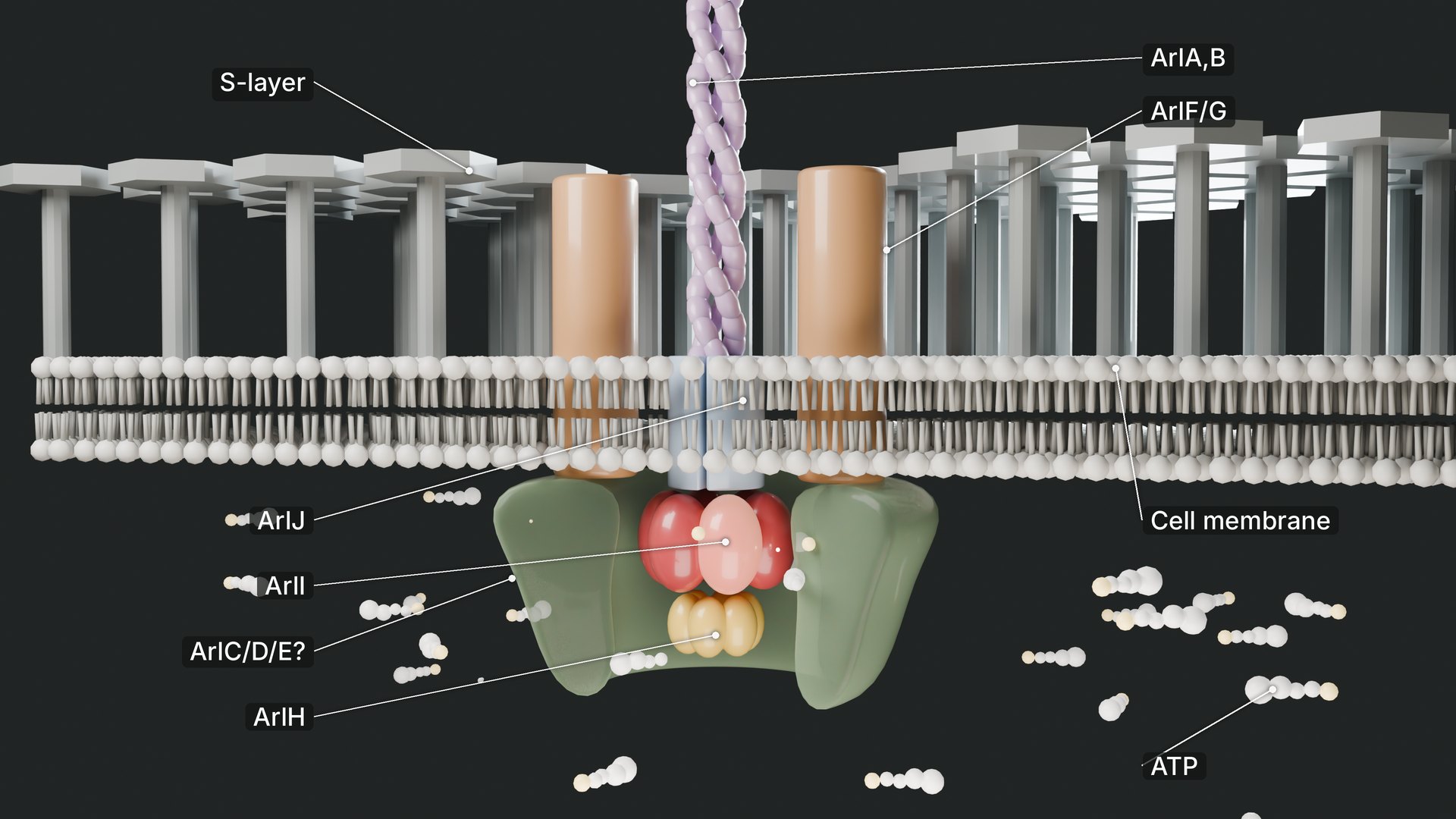
Archaea swim with the archaellum, an ATP-driven rotary machinery that is evolutionarily unrelated to the bacterial flagellum. Using the halophilic archaeon Halobacterium salinarum, we directly observed the rotation of the archaellum in swimming cells and resolved it into discrete steps. We developed cross-kymography to quantify motor function and filament shape together, and measured motor torque, which suggested a general model for ATP-driven rotary motors.
References Nat Microbiol (2016), Biophys Physicobiol (2018), Commun Biol (2019)
Ghost cells: linking chemistry to mechanical work
To relate motion directly to chemistry, the composition inside the cell must be controlled. We developed membrane-permeabilised "ghosts" that keep moving while their interior is set from outside. In M. mobile ghosts, we converted the linear gliding motion into a rotary motion that can be read out precisely.
In ghosts of the archaeon Haloferax volcanii, the archaellum kept rotating and showed high selectivity for ATP and negative cooperativity in ATP hydrolysis. We estimated that at least 12 ATP molecules are hydrolysed per revolution, and showed that the response regulator CheY promotes switching from counter-clockwise to clockwise rotation.
References Sci Rep (2018), PNAS (2020)
From motors to cell behaviour
How motors are positioned and used shapes how whole cells move. We have studied the positioning of the motility machinery in halophilic archaea, found that an insect gut symbiont wraps its flagella around its cell body to swim and glide, showed that the original E. coli K-12 strain performs chemotaxis through forward-and-backward swimming rather than run-and-tumble, and examined how flagellar polymorphism affects swimming in structured environments.
References mBio (2019), ISME J (2018), Sci Rep (2020), Biophys Physicobiol (2023)